


System design interview candidates
Strengthen your System Design foundation with clear visual explanations and practical context.

Earn ₹12–45 LPAwith system design skills
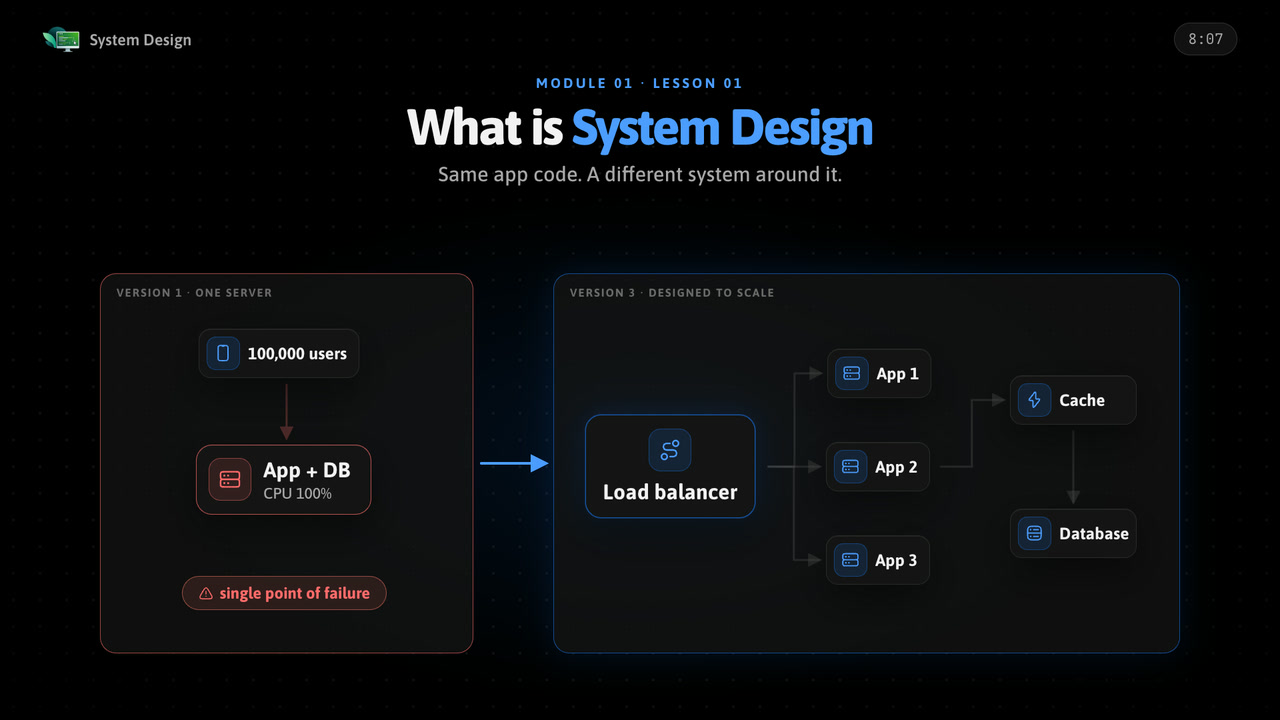
Crack system design interviews with 122 animated, voice-explained videos: scaling, caching, databases, distributed systems and 41 design problems.

Course preview
Watch free demo lectures from the course to see the visual, voice-explained teaching before enrolling.
Career outcomes
Use your System Design knowledge in portfolio projects, interviews, and practical work for roles such as these.
This System Design course turns important concepts into clear visual explanations you can learn in short sessions and revisit whenever you need a refresher.
Work through 122 videos at your own pace, apply each idea through structured examples and assignments, track your progress, and earn a certificate when you finish.
Build practical understanding through visual explanations, guided examples, and focused practice.
Build practical understanding through visual explanations, guided examples, and focused practice.
Build practical understanding through visual explanations, guided examples, and focused practice.
Build practical understanding through visual explanations, guided examples, and focused practice.
Strengthen your System Design foundation with clear visual explanations and practical context.
Fill knowledge gaps and apply System Design concepts more confidently in practical work.
Use structured lessons and focused practice to support projects, interviews, and career growth.
Topics
Syllabus
Review the System Design curriculum module by module, from core concepts through problem walkthroughs and mock interviews.
Understand what system design is, how the web works, and a repeatable framework for any design round.
Estimate QPS, storage, bandwidth and availability with quick back-of-the-envelope math.
Know the network and API building blocks: TCP/UDP, DNS, HTTP, REST, gRPC and real-time options.
Scale from one server to millions of users with load balancers, proxies and stateless services.
Pick the right caching strategy, handle cache failures, and use CDNs; then design a distributed cache.
Choose between SQL and NoSQL, and understand indexes, transactions and isolation levels.
Scale databases with replication, sharding and consistent hashing; design an ID generator and URL shortener.
Decouple services with queues, pub-sub and Kafka; design a message queue and a notification system.
Store files and objects at scale and build search; design typeahead autocomplete.
Reason about CAP, consistency, quorums and consensus; design a key-value store and a distributed lock.
Build resilient systems with retries, circuit breakers, rate limiting and sagas; design a rate limiter.
Compare monoliths and microservices, service communication, and batch vs stream processing.
Ship to production with observability, auth, security and safe deployments.
Use probabilistic data structures; design a web crawler, top-K trending and an online judge.
Choose push vs pull feeds; design Twitter's news feed, Instagram and a real-time leaderboard.
Handle real-time messaging and collaborative editing; design WhatsApp and Google Docs.
Build video pipelines and file sync; design YouTube and Dropbox.
Index location data; design Yelp, Uber and a food delivery app.
Handle contention and money safely; design ticket booking, payments, flash sales and a stock exchange.
Separate OLTP and OLAP; design a job scheduler, metrics system, ad click aggregation and S3.
Use embeddings, vector databases and LLMs; design ChatGPT serving and a recommendation system.
Apply OOP, SOLID and UML, and know how to approach a low-level design round.
Use creational, structural, behavioral and concurrency patterns in real code.
Solve classic LLD rounds: parking lot, elevator, Splitwise, vending machine and more.
Drive the interview with a cheat sheet and practise with three full mock interviews.
Courses grouped into a path, in the order we would teach them. One payment, and every course in the set gets 3 months of access per course in the set.
Crack coding rounds with DSA in C++, then clear the system design round.


DSA in Java, Spring Boot APIs, system design and DevOps for backend roles.



Automate with Python, ship with DevOps and design systems that scale.

Course certificate
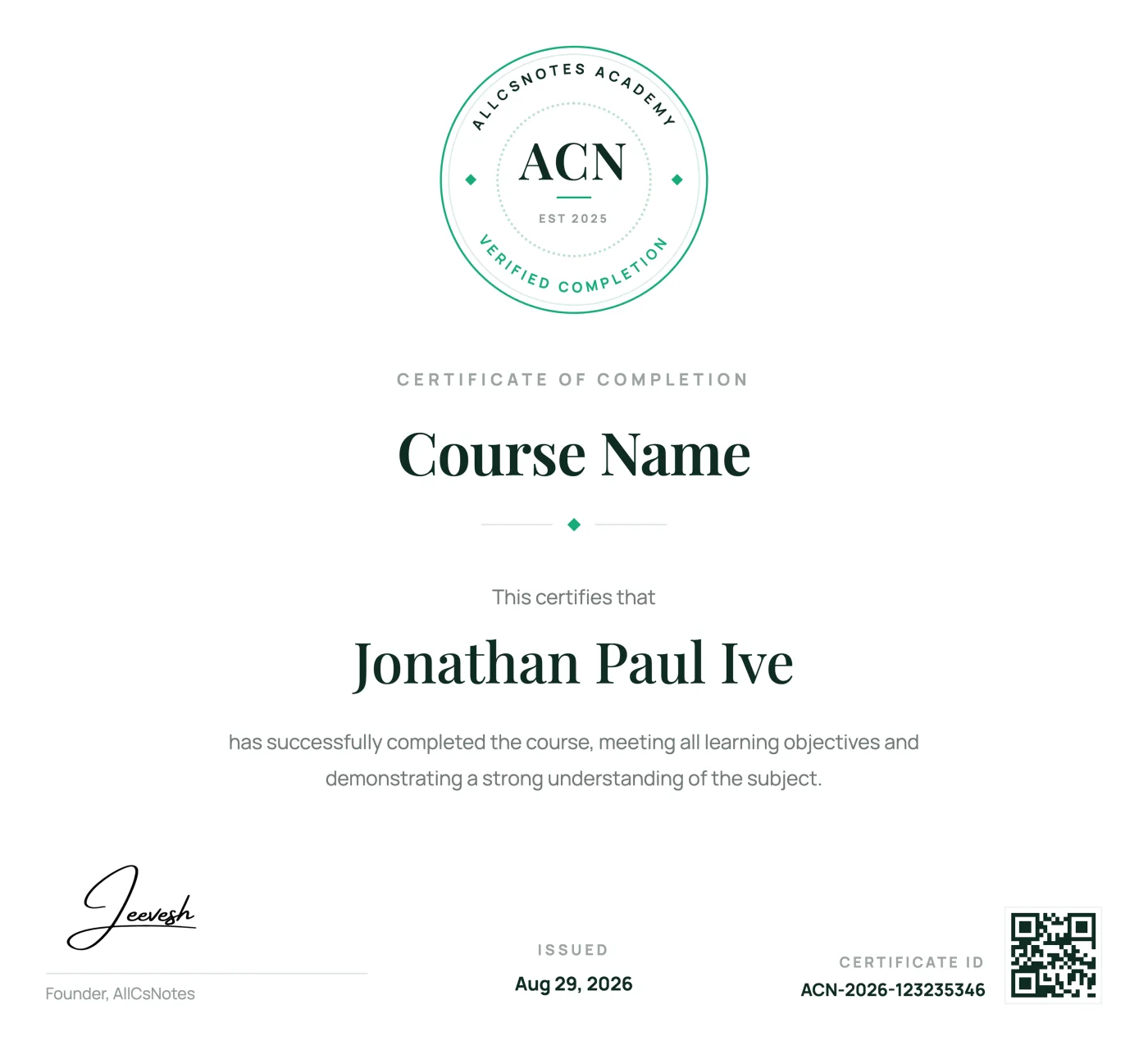
Complete every System Design lesson to earn a verified AllCSVideos certificate that demonstrates your commitment and newly developed skills.
Receive a unique certificate ID that confirms your completed course.
Add your achievement to LinkedIn, your portfolio, resume, or social profile.
Return to your certificate and learning record from your AllCSVideos account.
Real learning stories from people building practical skills with visual notes.
10,000+ verified public & course reviews
“The visual notes finally made React hooks click for me. I had watched several tutorials before, but this was the first time the concepts felt connected. I finished the course during one week of train rides.”
“I used one DSA lesson each morning and became much more confident explaining solutions in interviews.”
“Short pages, no filler. I stopped abandoning courses halfway once I switched to reading instead of watching.”
“The Python examples went straight into my project the same afternoon. Clear and practical from the first lesson.”
“I keep the SQL notes open while I work. Joins and window functions are easier to recall because I can find the exact visual explanation in seconds. It has become a daily reference, not just a course I completed.”
“My approach to system design became much more structured within a month of finishing the course.”
“The TypeScript course helped me understand the reason behind the types, not only the syntax. My project code feels much safer now.”
“I came for Next.js and stayed for the visual explanations. Server and client components finally make sense without replaying long videos.”
“The Node.js course connected routing, validation, security, and deployment into one clear mental model. I now understand how the pieces fit together in a production API.”
“Data Analytics felt much less intimidating once every workflow was broken into short visual steps. I could practice one idea at a time.”
“The DevOps notes gave me a practical path from containers to delivery pipelines. I return to the diagrams whenever I need to explain a workflow to my team.”
“Generative AI finally felt concrete. The sections on prompts, RAG, and evaluation helped me move from experiments to a project I could actually demonstrate.”