

All CS Videos

Data Science

Earn ₹5–28 LPAwith data science skills

Become a job-ready data scientist with 112 animated videos: Python, pandas, statistics, machine learning, PyTorch, LLMs, 5 builds and interview prep.

Data Science course banner
₹299₹1,99985% off
Checking your library...
4,700+ learners enrolled
One-time payment. 3 months access to every video in this course.
4.94,700+ ratings
Beginner to Job ReadySkill level
112 videos8 hours
CertificateShareable on finish

Course preview

See how the lessons work before you buy

Watch free demo lectures from the course to see the visual, voice-explained teaching before enrolling.

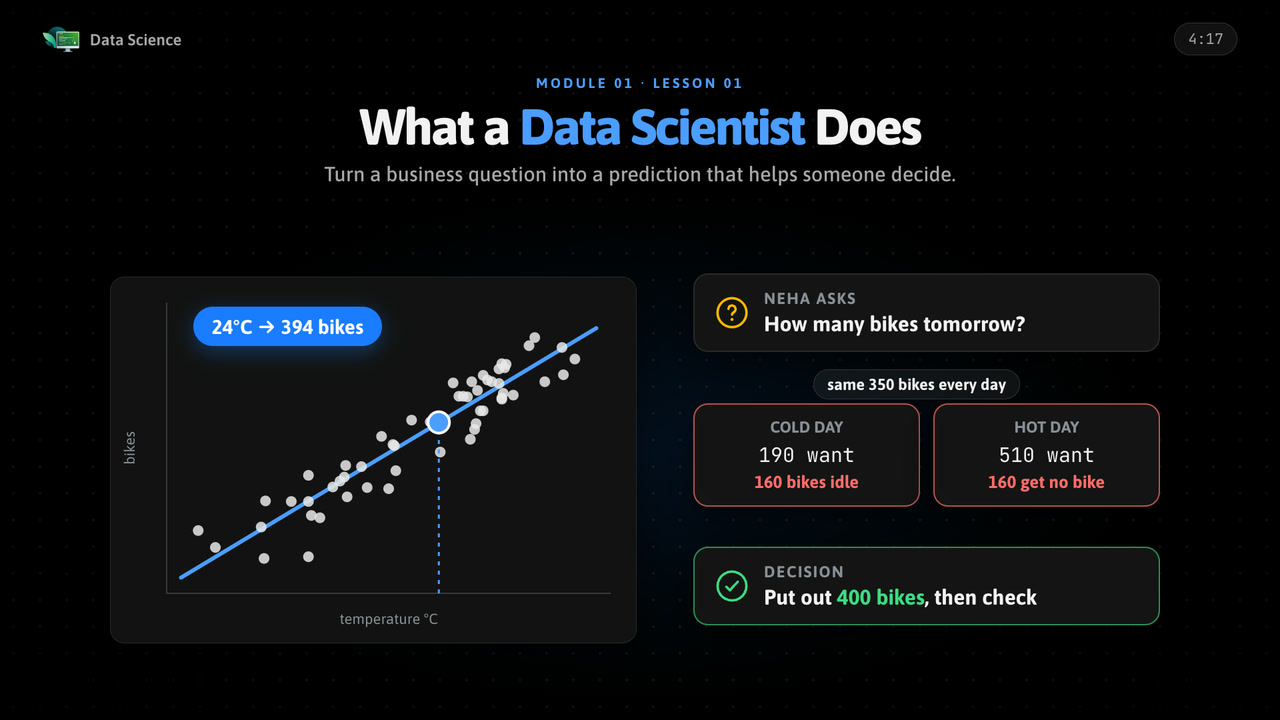
Data Science free demo: What a Data Scientist Does thumbnail

Free demo lectures8 videos

Career outcomes

Build skills that open doors to real roles

Use your Data Science knowledge in portfolio projects, interviews, and practical work for roles such as these.

01

Data Scientist

Entry level
02

Machine Learning Engineer

Mid level
03

Data Analyst

Senior track

About this data science course

This Data Science course turns important concepts into clear visual explanations you can learn in short sessions and revisit whenever you need a refresher.

Work through 112 videos at your own pace, apply each idea through structured examples and assignments, track your progress, and earn a certificate when you finish.

Skills you will learn

Python, numpy and pandas in Jupyter, charts, and the statistics, probability and maths models need

Build practical understanding through visual explanations, guided examples, and focused practice.

Regression and classification with scikit-learn, trees, forests and boosting, honest checks and no leaks

Build practical understanding through visual explanations, guided examples, and focused practice.

Clustering, PCA, time series forecasting, neural networks in PyTorch, images, text and local LLMs

Build practical understanding through visual explanations, guided examples, and focused practice.

Ship models with Streamlit and FastAPI, drift and fairness, 5 builds, a portfolio and interview prep

Build practical understanding through visual explanations, guided examples, and focused practice.

Who this course is for

Aspiring data analysts

Build a clear Data Science foundation with visual explanations that do not assume prior expertise.
Working analysts

Fill knowledge gaps and apply Data Science concepts more confidently in practical work.

Business and product professionals

Use structured lessons and focused practice to support projects, interviews, and career growth.

Topics

Python, numpy and pandas in Jupyter, charts, and the statistics, probability and maths models needRegression and classification with scikit-learn, trees, forests and boosting, honest checks and no leaksClustering, PCA, time series forecasting, neural networks in PyTorch, images, text and local LLMsShip models with Streamlit and FastAPI, drift and fairness, 5 builds, a portfolio and interview prepData Science fundamentalsPractical examplesDebugging techniquesProduction best practicesInterview preparation

Syllabus

What is inside the course

Review the Data Science curriculum module by module, from core concepts through five real builds, an end to end capstone and interview prep.

01What Data Science Is6 lessons • 24 min

Learn what a data scientist really does, from Neha's question to a working model: data science vs analytics, ML and AI, what a model is, the six-step process and the three kinds of questions.

What a Data Scientist Does4:17
Data Science vs Data Analytics vs Machine Learning vs AI4:05
What a Model Is: a Rule Learned from Examples3:56
The Data Science Process: Question, Data, Explore, Model, Check, Ship3:46
Kinds of Questions: Predict a Number, Predict a Group, Find Groups3:51
Tools of the Job and the Course Map3:56
02Setting Up the Lab4 lessons • 19 min

Set up your lab: install Python and JupyterLab, run your first notebook cells, make a virtual environment with pip, and meet the ZipRide data we use all course.

Install Python and JupyterLab4:41
Your First Notebook: Cells, Run, Restart4:20
Virtual Environments and pip4:19
Meet the ZipRide Data5:17
03Python Essentials4 lessons • 18 min

Just enough Python for data science: variables, numbers and text, lists and dictionaries, if, loops and functions, and reading errors without fear.

Variables, Numbers, Text, True or False5:03
Lists and Dictionaries4:36
If, Loops and Functions4:28
Reading Errors Without Fear4:07
04numpy4 lessons • 18 min

Learn numpy: one line instead of a loop, arrays, shape and indexing, maths on whole arrays with broadcasting, and random numbers with seeds.

Why numpy: One Line Instead of a Loop4:15
Arrays, Shape and Indexing4:48
Maths on Whole Arrays and Broadcasting4:52
Random Numbers and Seeds4:21
05pandas for Data Science5 lessons • 23 min

Work with tables in pandas: DataFrame and Series, loading and the first look, choosing rows and columns, groupby, merge and dates, and cleaning blanks, duplicates and wrong types.

DataFrame and Series4:13
Loading and the First Look4:34
Choosing Rows and Columns4:56
groupby, merge and Dates4:20
Cleaning: Blanks, Duplicates, Wrong Types4:31
06Seeing Data4 lessons • 1 build • 22 min

See your data with matplotlib and seaborn: histograms, box plots, scatter plots, a correlation heatmap and an EDA checklist, then explore ZipRide rides in Build 1.

matplotlib and seaborn Basics4:22
Distributions: Histogram and Box Plot4:25
Relationships: Scatter Plot and Correlation Heatmap4:20
Exploratory Data Analysis: a Checklist4:21
Explore ZipRide Rides4:44
07Statistics for Models5 lessons • 23 min

Statistics models need, in pictures: mean, median and spread, the normal curve and z scores, why samples wobble, hypothesis tests and P values, and why correlation is not causation.

Mean, Median and Spread4:18
The Normal Curve and Z Scores4:59
Sampling and Why Samples Wobble4:36
Hypothesis Tests and P Values in Plain Words4:31
Correlation Is Not Causation4:10
08Probability4 lessons • 17 min

Probability as counting: conditional probability, Bayes rule with a spam box, and expected value for real decisions.

Probability as Counting4:08
Conditional Probability4:15
Bayes Rule with the Spam Box4:29
Expected Value4:26
09Linear Algebra and Calculus, Only What Models Need5 lessons • 21 min

Only the maths models need: vectors, the dot product, matrices, slope and derivative, and gradient descent worked by hand.

Vectors: a Row Is an Arrow3:57
Dot Product: How Alike Are Two Rows4:30
Matrices: a Whole Table at Once4:22
Slope and Derivative: Which Way Is Downhill4:13
Gradient Descent by Hand4:18
10How Machine Learning Works5 lessons • 21 min

How machine learning works: features and target, the train and test split, a baseline to beat, underfitting and overfitting, and your first scikit-learn model in five lines.

Features and Target4:03
Train and Test Split: the Exam the Model Never Saw3:56
The Baseline: Beat the Dumb Guess First3:59
Underfitting and Overfitting4:22
Your First scikit-learn Model in Five Lines4:21
11Regression: Predicting a Number5 lessons • 24 min

Predict a number with regression: a line through the dots, many features, MAE, RMSE and R squared, polynomial features, and ridge and lasso.

Linear Regression: a Line Through the Dots5:59
Many Features: Multiple Regression4:29
Error Measures: MAE, RMSE, R squared4:26
Polynomial Features and the Wiggly Line4:30
Ridge and Lasso: Keeping the Model Calm4:26
12Classification: Predicting a Group6 lessons • 1 build • 32 min

Predict a group with classification: logistic regression, the decision boundary, the confusion matrix, precision, recall and F1, ROC and AUC, imbalanced classes, then Build 2: how many bikes tomorrow.

Logistic Regression: from a Line to a Probability4:18
The Decision Boundary4:29
The Confusion Matrix4:25
Precision, Recall and F14:38
ROC Curve and AUC4:25
Imbalanced Classes: When 95% Accuracy Is Useless4:28
How Many Bikes Tomorrow?5:05
13Trees and Forests5 lessons • 23 min

Trees and forests: decision trees as twenty questions, how a tree picks a split, random forests, gradient boosting with XGBoost, and feature importance.

Decision Trees: Twenty Questions4:24
How a Tree Picks a Split4:51
Random Forest: Many Trees Vote4:42
Gradient Boosting and XGBoost4:38
Feature Importance4:40
14Other Classic Models3 lessons • 14 min

Other classic models: k nearest neighbours, Naive Bayes and support vector machines, each drawn as a picture first.

k Nearest Neighbours: Ask the Neighbours4:40
Naive Bayes4:25
Support Vector Machines: the Widest Road4:35
15Making Models Better6 lessons • 1 build • 33 min

Make models better: feature engineering, scaling and encoding, pipelines with no leaks, cross validation, grid and random search, and data leakage, then Build 3: which riders will leave.

Feature Engineering: Dates, Categories, Ratios4:53
Scaling and Encoding4:55
Pipelines: No More Leaks4:27
Cross Validation4:33
Hyperparameter Tuning with Grid and Random Search4:40
Data Leakage: the Too Good to Be True Model4:09
Which Riders Will Leave?5:17
16Unsupervised Learning5 lessons • 23 min

Find patterns without answers: k-means, choosing k with the elbow and silhouette, DBSCAN and hierarchical clustering, PCA and anomaly detection.

Clustering with k-means4:25
Choosing k: Elbow and Silhouette4:22
DBSCAN and Hierarchical Clustering4:36
PCA: Squashing Many Columns into Two4:25
Anomaly Detection: the Odd Ride Out4:45
17Time Series and Forecasting4 lessons • 1 build • 23 min

Time series and forecasting: trend, season and noise, lags and rolling windows, forecasting done right and measuring a forecast, then Build 4: rider groups and a weekly forecast.

Trend, Season and Noise4:27
Lags and Rolling Windows4:10
Forecasting with a Model, Done Right4:03
Measuring a Forecast4:27
Rider Groups and a Weekly Forecast6:00
18Neural Networks5 lessons • 26 min

Neural networks from one neuron: layers and activations, loss and backpropagation in pictures, your first network in PyTorch, and dropout and early stopping.

One Neuron by Hand4:42
Layers and Activation Functions5:09
How a Network Learns: Loss and Backpropagation in Pictures4:57
Your First Network in PyTorch5:06
Overfitting in Networks: Dropout and Early Stopping5:45
19Images and Text6 lessons • 30 min

Images and text: pixels as numbers, convolutional networks, transfer learning on bike photos, bag of words and TF-IDF, sentiment of reviews and embeddings.

How a Computer Sees a Picture: Pixels as Numbers4:48
Convolutional Networks4:57
Transfer Learning: OK or Damaged Bike?4:40
Text as Numbers: Bag of Words and TF-IDF5:03
Sentiment of ZipRide Reviews5:05
Embeddings: Words as Dots in Space5:14
20Large Language Models for Data Scientists3 lessons • 14 min

Large language models for data scientists: what an LLM is, labelling reviews with a local LLM, and checking AI code and AI numbers.

What an LLM Is, in Pictures4:50
Using a Local LLM to Label Reviews4:54
Checking AI Code and AI Numbers4:40
21From Notebook to Product5 lessons • 22 min

From notebook to product: save a model, build a Streamlit app, serve a FastAPI prediction API, track experiments and catch model drift.

Saving a Model4:22
A Streamlit App: Neha Gets a Button4:15
A Prediction API with FastAPI4:41
Tracking Experiments4:14
Model Drift: When the World Changes4:02
22Ethics and Explaining Models3 lessons • 13 min

Ethics and explaining models: bias in data and fair models, explaining a single prediction, and privacy and responsible data.

Bias in Data and Fair Models4:14
Explaining a Prediction4:21
Privacy and Responsible Data4:11
23Your Career5 lessons • 1 build • 23 min

Your career: data science roles, portfolio projects and GitHub, resume and LinkedIn, the ML case study interview and the questions you will be asked, then the end to end capstone.

Data Science Roles: Analyst, Scientist, ML Engineer3:37
Portfolio Projects and GitHub3:28
Resume and LinkedIn for Data Scientists3:30
The ML Case Study Interview3:37
Interview Questions You Will Be Asked3:40
Capstone: ZipRide End to End5:34
23Modules
112Videos
107Lessons
5Builds
Combos

Learn a whole skill, not one topic

Courses grouped into a path, in the order we would teach them. One payment, and every course in the set gets 3 months of access per course in the set.

RecommendedSave 10%

Data Science & Python Combo

Learn Python properly from zero, then use it to build real machine learning models, from pandas and scikit-learn to PyTorch, Streamlit and interview prep.


Data Science
112 videos · Beginner to Job Ready
Python
120 videos · All Level
₹538₹598

2 courses · 5 months access to each

Get this combo
Interview readySave 10%

C++ Interview Prep Combo

Crack coding rounds with DSA in C++, then clear the system design round.

DSA with C++
218 videos · All Level
System Design
122 videos · All Level
₹538₹598

2 courses · 5 months access to each

Get this combo
Most popularSave 20%

Java Backend Engineer Combo

DSA in Java, Spring Boot APIs, system design and DevOps for backend roles.

DSA with Java
218 videos · All Level
Spring Boot
105 videos · All Level
System Design
122 videos · All Level
DevOps
110 videos · All Level
₹957₹1,196

4 courses · 9 months access to each

Get this combo
Longer access with more courses (3 courses = 7 months each)A certificate for each course in the combo
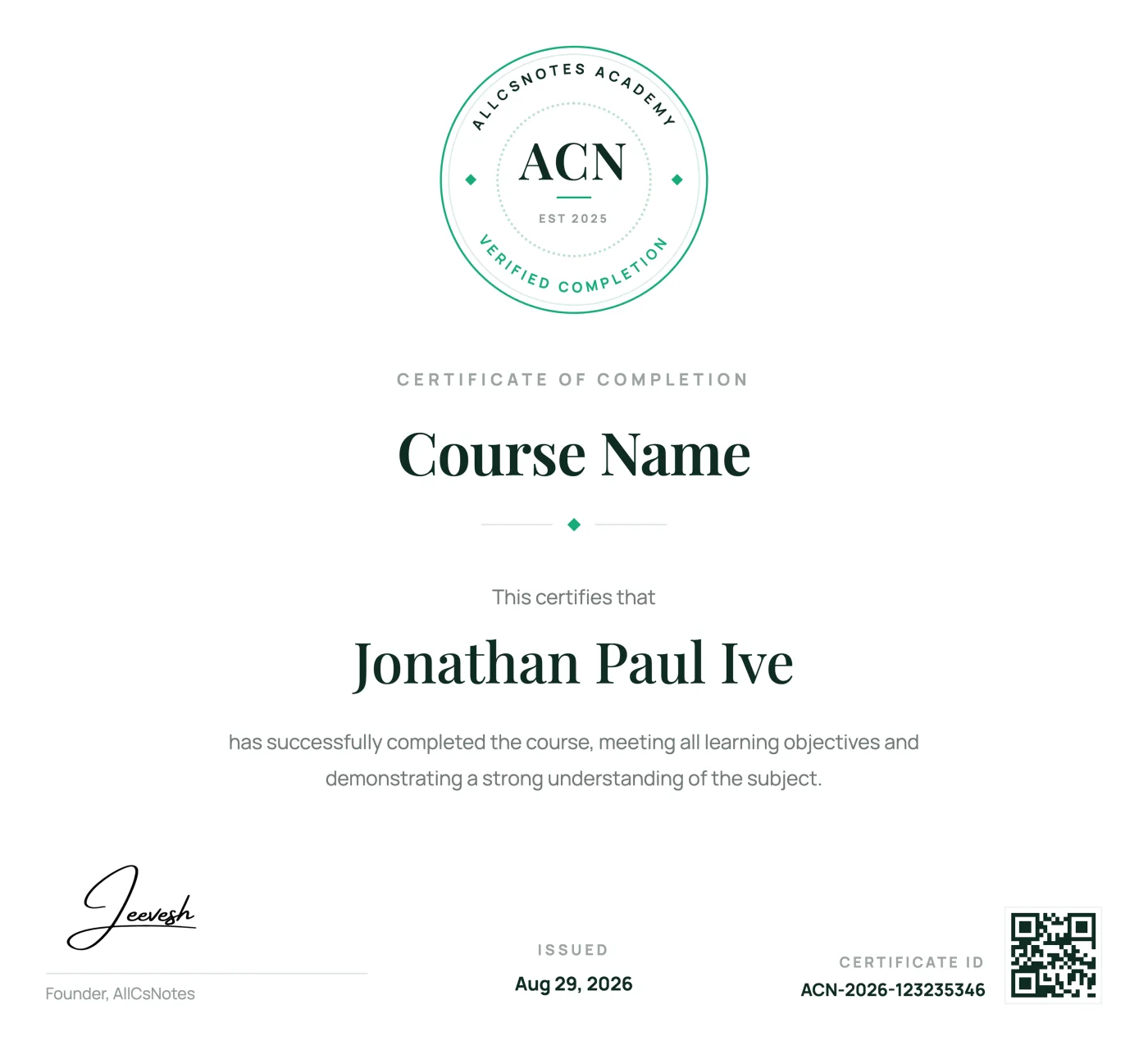
Data Science verified course completion certificate

Course certificate

Showcase your skills with a course certificate

Complete every Data Science lesson to earn a verified AllCSVideos certificate that demonstrates your commitment and newly developed skills.

Verified proof of completion

Receive a unique certificate ID that confirms your completed course.

Ready to share

Add your achievement to LinkedIn, your portfolio, resume, or social profile.

Accessible whenever you need it

Return to your certificate and learning record from your AllCSVideos account.

Checking your library...
Testimonials

What learners say after finishing

Real learning stories from people building practical skills with visual notes.

4.8/5

10,000+ verified public & course reviews

Learner story
“The visual notes finally made React hooks click for me. I had watched several tutorials before, but this was the first time the concepts felt connected. I finished the course during one week of train rides.”
Aanya S.
Aanya S.
React
Learner story
“I used one DSA lesson each morning and became much more confident explaining solutions in interviews.”
Shruti P.
Shruti P.
Data Structures and Algorithms
Learner story
“Short pages, no filler. I stopped abandoning courses halfway once I switched to reading instead of watching.”
Arjun T.
Arjun T.
JavaScript
Learner story
“The Python examples went straight into my project the same afternoon. Clear and practical from the first lesson.”
Fatima S.
Fatima S.
Python
Learner story
“I keep the SQL notes open while I work. Joins and window functions are easier to recall because I can find the exact visual explanation in seconds. It has become a daily reference, not just a course I completed.”
Rahul M.
Rahul M.
SQL
Learner story
“My approach to system design became much more structured within a month of finishing the course.”
Ishita R.
Ishita R.
System Design
Learner story
“The TypeScript course helped me understand the reason behind the types, not only the syntax. My project code feels much safer now.”
Dev P.
Dev P.
TypeScript
Learner story
“I came for Next.js and stayed for the visual explanations. Server and client components finally make sense without replaying long videos.”
Ishaan R.
Ishaan R.
Next.js
Learner story
“The Node.js course connected routing, validation, security, and deployment into one clear mental model. I now understand how the pieces fit together in a production API.”
Kabir N.
Kabir N.
Node.js
Learner story
“Data Analytics felt much less intimidating once every workflow was broken into short visual steps. I could practice one idea at a time.”
Rohan K.
Rohan K.
Data Analytics
Learner story
“The DevOps notes gave me a practical path from containers to delivery pipelines. I return to the diagrams whenever I need to explain a workflow to my team.”
Aman V.
Aman V.
DevOps
Learner story
“Generative AI finally felt concrete. The sections on prompts, RAG, and evaluation helped me move from experiments to a project I could actually demonstrate.”
Meera A.
Meera A.
Generative AI
Questions

Frequently asked questions

Still have questions? Let's talk

Learner finding answers about visual computer science courses
Are these video courses?
Yes. Every lesson is a short animated video with voice explanation, so you can watch, pause, and rewatch any concept whenever you need a quick explanation.
How long does one course take to finish?
The DSA with C++ course has 218 videos with more than 25 hours of content, the DSA with Java course has 218 videos with more than 26 hours, the DSA with Python course has 218 videos with more than 26 hours, the System Design course has 122 videos with more than 32 hours, the Spring Boot course has 105 videos with more than 24 hours, the Generative AI course has 98 videos with more than 25 hours, the DevOps course has 110 videos with more than 32 hours, the Python course has 120 videos with more than 34 hours, the React course has 114 videos with more than 24 hours, the TypeScript course has 120 videos with more than 24 hours, the Performance Marketing course has 100 videos with more than 5 hours, the AI Video Creation course has 70 videos with about 4 hours, the SQL course has 114 videos with about 6 hours, and the Computer Networks course has 135 videos with about 9 hours, the Flutter course has 144 videos with about 11 hours, the Cybersecurity course has 131 videos with about 11 hours, the Data Analytics course has 118 videos with about 7 hours, the Data Science course has 112 videos with about 8 hours, and the HR Management course has 116 videos with about 9 hours. Most lessons take under fifteen minutes. Your completion time depends on your pace, but you can make useful progress every day.
How long do I get access?
Each purchase gives you 3 months of access. You can renew anytime for the same price. If you renew early, the new 3 months are added after your current access ends, so you lose no days.
Do I get a certificate?
Yes. You receive a certificate after completing each eligible course. It can be shared as evidence of the topics and practical skills you covered.
What skill level do I need to start?
The course begins at a beginner level and requires no previous DSA experience. Basic C++ is covered in the first module, so you can start from the beginning.
Do I keep access to my course?
You keep access for 3 months from your purchase. After that you can renew at any time, and your saved progress is waiting for you when you come back.
Do the lessons get updated?
Yes. When an important tool, technique, or standard changes, affected lessons are updated and the new version appears in your course at no extra cost.